
Nielsen Using Its Wearable Devices to Measure Co-Viewing
New methodology lifts total viewers for big sporting events by 4.1%

Measuring TV viewing is hard. Even using big data, it is tough to measure how many devices are being served content and commercials. The next level of difficulty is counting how many people–if any–are actually in the room and watching when a show or ad airs.
That’s data people will pay for. Last month, Viant paid $40 million to buy TVision. TVision has a panel of viewers who agree to be on camera while they watch TV. TVision is best known for using its panel to determine how much attention viewers are paying to what’s on the screen. But it also provides good data about how many people are in the room. TVision’s method seems to be a lot more believable than most of the estimates used to provide co-viewing data.
Nielsen is looking to boost its co-viewing game. The technology it used in a test is a wristwatch-like device that its panelists wear that can detect signals from programs and commercials. The device is already being employed for Nielsen's measurement of out-of-home viewing, which has been adding viewers to football games and other sports telecasts to the delights of ad-selling sports programmers.
Similarly, Nielsen says that new methodology for measuring co-viewing delivered a 4.19% average increase in total viewers when it was employed to measure live events in February including the Super Bowl, Olympics opening ceremony, NBA All-Star Game, Daytona 500, Olympic closing ceremony, the gold medal Olympic hockey final and the State of the Union Address.
Nielsen currently tries to ascertain the number of people in the room when the set is on by asking its panelist to periodically push buttons on its people meters. Panelists wearing the newer devices won’t have to punch in to indicate their presence–and the new passive system is expected to yield a more accurate picture of co-viewing.
“Our Co-Viewing pilot exemplifies our unwavering commitment to providing the most accurate measurement for our clients during these dynamic times of change,” said Nielsen CEO Karthik Rao. “In the past year alone we’ve made continued enhancements to our ratings to better reflect the power of live TV in reaching massive audiences.”
Nielsen said the results from the co-viewing pilot program will not be included in final and official Big Data+Panel ratings for Nielsen clients at this point. That means it will not be considered part of the currency data used to buy and sell TV advertising in the upfront.
Nielsen said it aims to have the co-viewing methodology fully implemented into its media intelligence products–including its Big Data+Panel currency data–in time for the 2026-27 season.
That means the numbers used to set guarantees in the upfront will be different from those actually delivered in during the season.
We had questions about this new co-viewing data. For example, what is the demographic breakdown of these 4.1% more viewers? Nielsen has provided a more detailed report to its clients, but declined to share that information publicly.
At this point, Nielsen has only calculated the co-viewing for February’s big sports events but eventually the same methodology will be used for all programming Nielsen measures. So at this point, we don’t know how it will affect the audiences for dramas, comedies, reality shows and regular news programming.
Nielsen said it will be sharing additional impact data with clients throughout the year.
YOUTUBE REMOVED 15% MORE VIDEOS IN 2025: VAB REPORT
At a time when many advertisers are concerned about appearing alongside brand-safe content, the VAB, which represents mostly traditional TV companies, is pointing out how much unacceptable content appears on YouTube, which takes in the largest share of TV usage.
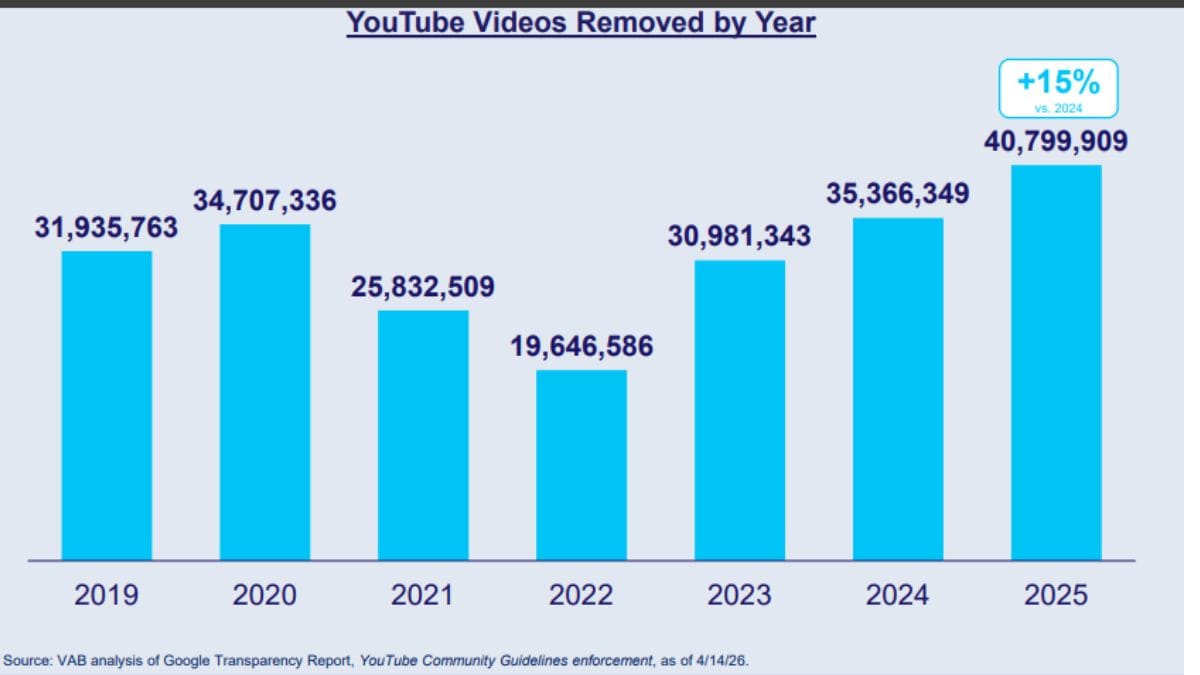
In 2025, YouTube removed 40,799,909 videos, up 15% from a year ago. That’s the equivalent of 965 years worth of video.
The number of videos removed has increased in each of the last three years.
“Our commitment to removing violative content and regular transparency reporting gives advertisers confidence to partner with YouTube and support our creators,” said Boot Bullwinkle, a YouTube spokesperson.
According to the company, YouTube also sets a higher bar for content that is eligible for monetization on the platform. For creators to earn ad revenue, videos must comply with the YouTube Partner Program policies, which include the company’s AdSense policies and Advertiser-friendly content guidelines.
The VAB noted that the two top reasons why YouTube removes material are because it threatens child safety or features content that is deemed dangerous, violent or graphic.
Over the past six years, 55.8% of the videos that were taken down were viewed at least once before they were removed, the VAB noted.
YouTube also removed 15.9 million channels in 2025. That’s down 56% from the prior year. A whopping 86.1% of the channels were removed because of spam and scams, which VAB says could mean bots or nefarious actors.
In addition, YouTube dropped 5.6 billion comments, up 5% from 2024, with 73.7% representing spam, misleading content or scams.
Over the last seven years, YouTube has had to remove 291.3 million videos, 154.4 million channels and 30.3 billion comments from its platform.
“A video sharing platform where hundreds of thousands of users upload content every day requires constant moderation and vigilance. For YouTube, the top reasons why content is removed include child safety issues, harassment & cyberbullying, hateful or dangerous speech, pornography, violence and violent extremism, graphic images and spams & scams,” VAB said in its report.
The VAB noted that YouTube does not share how long content that violated its guidelines remains on the platform before it gets reviewed and removed.
“The sheer scope of content removal and opaqueness of the process begs the question of just how much ‘unsafe’ content – from both a consumer and brand perspective – gets posted and continues to live on the platform, especially as millions of videos and channels are continually taken down and billions of comments are deleted annually,” the VAB said.
YouTube notes that the percentage of views of videos that violate its rules was 0.14-0.15% in Q4 2025. That means for every 10,000 views on YouTube, between 14 and 15 were of content that violated YouTube’s Community Guidelines.
NEXXEN INFLUENCES TV BUYS
Video ad platform Nexxen has made a deal with ADVolution that will enable political advertisers to make programmatic buys of TV, CTV and digital video based on audiences built using data on viewers based on the influencers they frequent on line.
When the influencer data is complemented with traditional voter data and contextual signals, political advertisers can reach voters more effectively, programmatically activating and measuring campaigns within a single environment, the companies said.
“Traditional voter data helps define audiences, fandom signals tell you what moves them,” said Kara Puccinelli, chief customer officer, Nexxen. “Our partnership with ADvolution provides political advertisers a way to reach communities that form around influential personalities, so campaigns can show up in high-attention environments and deliver messaging that reflects that cultural context surrounding those moments.”
The arrangement comes as we approach a midterms election that is expected to break records–and see a big uptick in CTV use by candidates.
“We are incredibly excited to see this application in the political sector, empowering campaigns to engage voters within the communities and shared interests that shape their worldviews,” said Alex Chatfield, co-founder and president of ADvolution. “For too long, high-value audiences have remained invisible to traditional targeting. By integrating our fandom signals into the Nexxen DSP, we are finally giving advertisers the tools to target those 'hard-to-reach' communities where true influence and conversation reside. The partnership with Nexxen is a strong validation of ADvolution's intelligence and our mission to unlock the power of digital subcultures to drive value across the ecosystem.”