
Nexxen Takes Smart TV Home Screen Ads Programmatic
‘By activating this high-impact media in Nexxen’s unified platform, advertisers can not only engage those audiences but also link that exposure to performance across the funnel,’ said Nexxen’s Kara Puccinelli

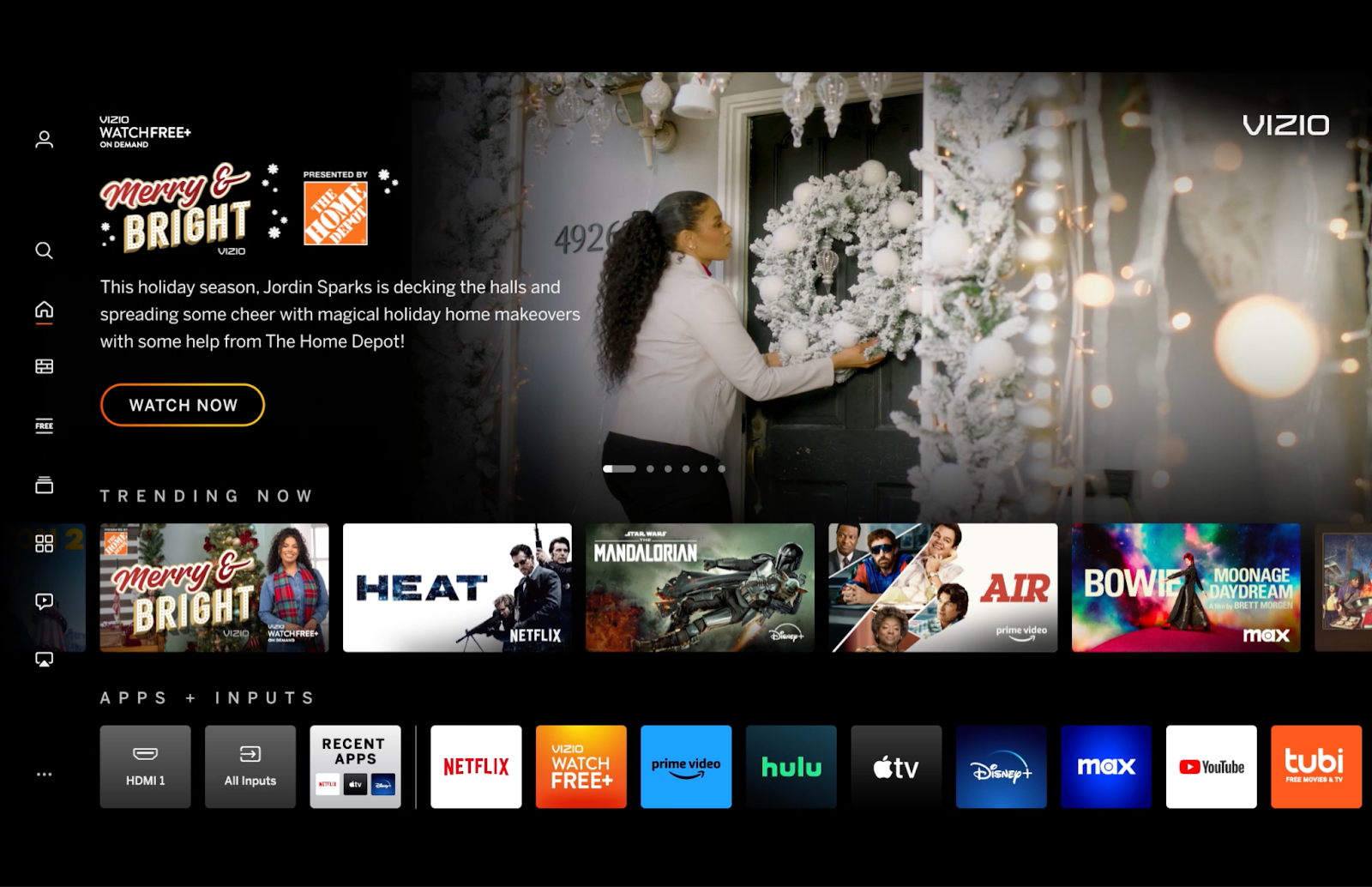
Ads on TV home screens are being positioned as prime real estate by smart set makers, and the race is on to buy and sell those commercial units programmatically.
Nexxen says it has made a deal with independent agency H/L that will enable the agency to buy home screen ads using private marketplace deals and its demand-side platform, the Nexxen DSP.
The feature, Nexxen TV Home Screen, is designed to help marketers reach viewers when they are deciding what to watch.
During last month’s NewFront presentations, set makers such as Vizio, Samsung and LG all touted home screen ads as a place where large audiences could be reached.
“As consumers continue to divide their time and attention across screens, brands need ways to connect with them during moments when the TV has their full focus, and Nexxen TV Home Screen creates that opportunity,” said Kara Puccinelli, Nexxen’s chief customer officer, Nexxen. “By activating this high-impact media in Nexxen’s unified platform, advertisers can not only engage those audiences but also link that exposure to performance across the funnel.”
H/L is using home screen inventory to generate early exposure that primes viewers so that when the later :30 or :15 spots play, they are more likely to recall the message and listen.
“CTV is not traditional television, and relying on it to behave the same way is why campaigns can underperform. Consumer behavior has changed, making it critical to maximize the moments when you actually have the audience’s attention. Inventory like Nexxen TV Home Screen puts brands in front of engaged viewers, helping capture and build on that attention from the very start,” said Jeremy Cobb, VP, Digital Platforms at H/L.
“The reality is viewers are often scrolling, searching or gaming during ad breaks. Creating more focused exposure earlier in the viewing journey helps ensure that when pod spots run, the message actually lands," Cobb said.
# # #
If you need more data showing that contextual targeting boosts the effectiveness of television advertising, check out this research from VideoElephant’s new report, The Power of Context: Driving Lift Through Video.
Based on a survey of 2,000 U.S. adults conducted by Talker Research, 41% of consumers said they had a positive view of a brand when its commercial was paired with contextually relevant content.
The study also found that 74% of respondents said that a brand’s values significantly influence their purchasing decisions, with nearly one-third calling it a "critical" factor. Additionally, 80% of consumers are more receptive to advertising when three relevancy markers align: personal relevance, content adjacency and physical venue.
Most importantly, 70% of consumers reported taking direct action — from discovery to purchase — after engaging with video ads across in-home, digital and OOH platforms.
"The data confirms that consumers don't just 'see' an ad; they experience the environment it lives in," said Brian Cullinane, Chief Commercial Officer at VideoElephant. "When you align the right creative with the right content in the right venue, you aren't just buying an impression — you're borrowing the trust and authority of that environment. It’s the difference between being an interruption and being a resource.”
The study also said that 65% of viewers prefer video ads that are integrated into relevant content rather than stand-alone loops, and 83% of consumers expressed an openness to learning something new via CTV out of home.
# # #
A lot of money is being spent on political ads this year. According to a new forecast from Kinetiq Political Insights, candidates and interest groups will pour $10.4 billion into media, making this the most expensive non-presidential election in U.S. history.
The biggest slice of that campaign cash will go to broadcast TV. That $4.8 billion haul is up 9% from the 2022 midterms, but broadcast share is down to 46.2% from 49%.
The dollars going to CTV and streaming will more than double to $2.7 billion from $1.2 billion during the last midterms. No medium in political advertising history has scaled this fast, Kinetiq said.
Other digital spending will be up 11.3% to $1.2 billion.
Cable TV will get $1.2 billion, up 6%, while spending on radio drops 17% to $300,000.
A lot of the spending will happen in Michigan where there are races for the U.S. Senate, governor and three contested house seats. That means viewers will be bombarded with $1 billion worth of political ads.
Spending levels will also be high in Georgia ($900 million), California ($773 million), North Carolina ($634 million) and Ohio ($614 million).
From a business point of view, Kinetiq notes that the $4.8 billion in broadcast political spending flows disproportionately through three publicly traded station groups, led by Nexstar, which has stations in Atlanta, Phoenix, Philadelphia and Cleveland. Political spots require no sales commissions, no agency discounts and minimal make-good obligations — delivering 65–75% gross margin versus 35–45% on commercial ad sales.
The $2.7 billion in political money going into CTV flows primarily through DSPs, such as The Trade Desk.
In competitive markets, political advertising preempts 15–20% of commercial inventory in September and October. Consumer brands face CPM increases of 20-40% in political DMAs. In Atlanta and Las Vegas, the displacement will be acute.
National advertisers shift budgets toward streaming and digital — benefiting Google, Meta, and Amazon at the direct expense of local stations.
During the final two weeks before Election Day advertisers should expect to see a 32% rate premium because political inventory is a perishable commodity, Kinetiq says.