
What do people actually want from AI? Shift Browser asked before building.
We sat down with Shift’s VP of Product, Michael Foucher, to talk about coding with AI, watching the market evolve, and how Shift is taking a context-aware, privacy, and real-world approach to AI integration.

Quick question: have you heard of this thing called AI?
Better question: are you tired of hearing about it?
Over the past few years, AI has dominated nearly every conversation in the digital sphere. Every tech company, consumer-facing and B2B alike, is racing to integrate it into their stack.
While the broader AI discourse can feel exhausting, here’s something refreshing: Shift Browser surveyed both everyday consumers and power users before rolling out its AI strategy, choosing a more deliberate path instead of sprinting to ship.
Which makes sense. Shift’s entire mission is building a fully customizable browser. So, why would Shift AI be any different?
We sat down with Shift’s VP of Product, Michael Foucher, to talk about coding with AI, watching the market evolve, and how Shift is taking a context-aware, privacy, and real-world approach to AI integration.
This interview has been lightly edited for clarity and brevity.
Q: You mentioned your personal AI journey started like most users, with ChatGPT. What changed for you?
Michael: Like everyone, my first exposure was OpenAI and ChatGPT, typing in queries, summarizing documents, helping with tone. For a while, it felt like a lot of spaghetti being thrown at the wall to see what stuck.
Over time, what really stood out was how strong AI became at writing code.
I had a workflow problem. I was getting tasks from Jira, Asana, Gmail, Slack and things were falling through the cracks. So I started building a Chrome extension that would embed a button inside Slack or Gmail and send tasks directly to Apple Reminders and it worked.
That was the moment it really opened my mind to what’s possible.
Q: There are already AI-first browsers in the market. What did you learn watching them?
Michael: Mid last year, Perplexity launched Comet, which was one of the first AI-first browsers. It introduced this concept of “agentic browsing” driving pages and doing smart actions on your behalf. Shortly after that, OpenAI launched Atlas, which has similar AI-native browsing functionality. The Browser Company launched Dia. There are lots of interesting ideas out there.
We’ve been fortunate to watch and see what sticks. Shift’s strength is different: We’re the world’s first fully customizable browser. People use Spaces and Apps to organize different parts of their lives, including work, passion projects and side projects. So we asked: how do we incorporate AI in a way that leverages what’s already important to our users?
Q: What does that look like inside Shift?
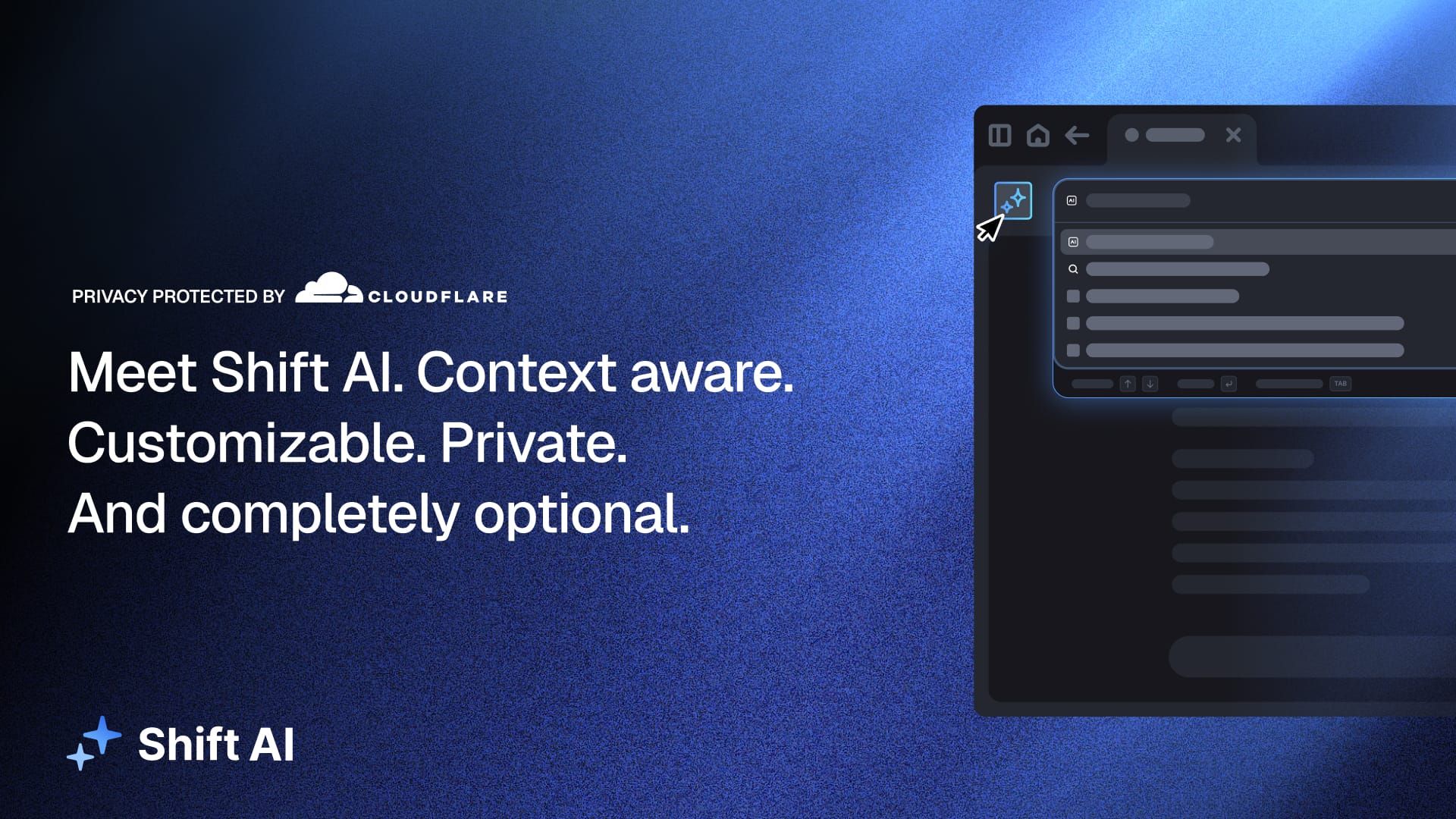
Michael: We’re introducing Shift AI as a chat interface that can slide out inside the browser. When you open it, it automatically grabs context from where you are. If you’re in Jira and have multiple stories open, the AI already knows that. You can immediately ask for a summary of those tickets without manually copying links.
We’re also launching an Intelligent Omnibox. As you type into the Omnibox, we use a locally trained embedded model that predicts—at around 90% accuracy—whether your query is better suited for a traditional search or an AI response. If it thinks AI would be better, you hit Tab and it opens Shift AI. If not, you hit Enter and it runs a normal search. We’re not forcing users into AI—we’re suggesting it.
Q: How does Shift AI maintain the core mission of customization and personalization?
Michael: Shift AI is designed to be seamless and uphold the founding principle of customizing the entire browser experience. A key feature is context awareness:
The goal is to be a step ahead by anticipating what the user wants in different contexts. Users maintain control and can easily remove the context or create a new chat to clear it.
This means you can immediately ask questions—for instance, asking for a summary and latest status of four open JIRA stories—without having to individually add those pages into the chat.
When you open the AI chat within an app (installed in Shift) that has multiple tabs open, the AI chat window automatically gathers the context from all those open tabs.
Q: You’ve emphasized privacy. How are you handling AI queries from a security standpoint?
Michael: Privacy is extremely important to us: All queries are proxied through our own systems and additional security layers with Cloudflare. With Shift AI, there’s no way to trace queries back to the individual user.
We don’t store queries centrally—only locally on the user’s machine. We’re committed to ensuring user data is never used for advertising purposes.
Q: What’s next for Shift and AI?
Michael: The landscape is changing fast, so I won’t pretend to predict where everything goes. What I can say is that we’ll continue leaning into what users love about Shift and that is the ability to customize, to organize apps and profiles into Spaces and use AI to augment that.