
Female Gamers a High-Value — But Often Ignored — Audience
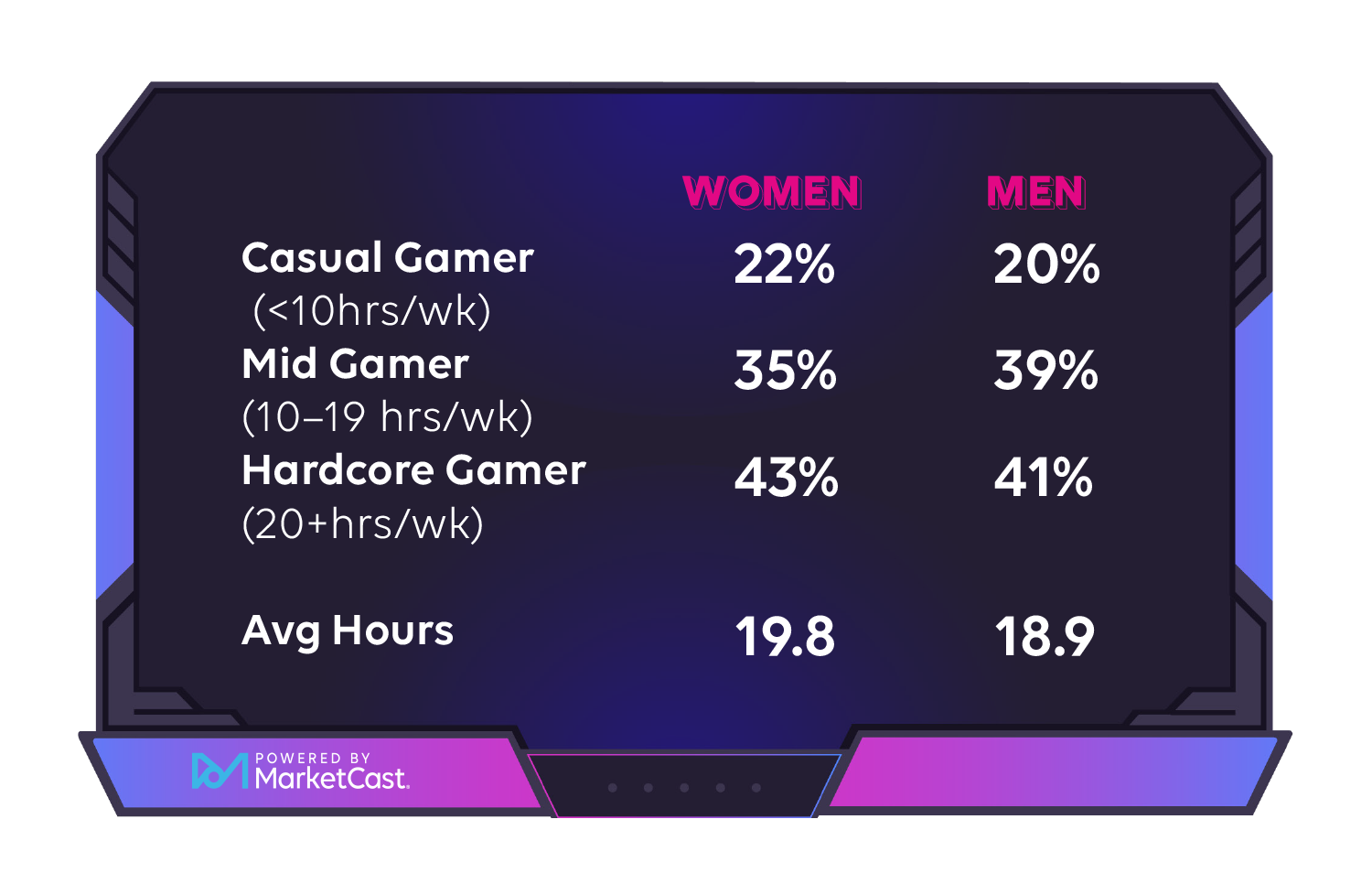
43% of women identified as “hardcore gamers,” logging 20 or more hours per week — surpassing the 41% of men who do the same, per MarketCast.


New research from MarketCast reveals that women are gaming just as much as men — and in some cases, even more. Yet in a cultural landscape where video games are one of the dominant forms of entertainment, long-standing gender assumptions continue to shape public perception. The idea that gaming is a “male” activity isn’t simply about who picks up a controller; it’s tied to decades of history, culture, economics and representation within the industry. And even today, despite the rise of prominent female gamers and influencers, many still assume men game more frequently.
But that assumption doesn’t hold up.
MarketCast’s “Women in Gaming” report, which surveyed more than 1,600 females over age 13 and nearly 400 men over age 18, found that 43% of women identified as “hardcore gamers,” logging 20 or more hours per week — surpassing the 41% of men who do the same. Looking at average hours overall, women clock almost an hour more per week than men, 19.8 to 18.9.
Although women are more likely to play free games (73%, compared to 46% of men), they’re also ok with shelling out for in-game content with real money, as cited by 64% of women ages 18-34.
This, of course, has real implications for video game marketers. Female gamers should be treated as a primary, high-value and engaged audience, and marketing efforts should focus on long-term investment and in-game purchase opportunities.
When it comes to the types of games that women are playing, MarketCast drops another myth-buster: They have diverse habits and aren’t solely focused on cozy games. Among PC/console players, women demonstrate a strong interest in shooters (like Call of Duty) and puzzle games. And in fact, among the 18-34 demographic, shooters are the #1 genre for women, mirroring their male counterparts.
The study also highlights a distinct “mobile-only” cohort, a group that skews older (49% are 50+) and gravitates toward single-player, puzzle and casino titles. But their interest extends well beyond casual downtime; they’re motivated by progression, a sense of mastery and the cognitive challenge of tackling difficult problems.
Given this, marketers should ensure their campaigns reflect the full spectrum of gamer identities by showcasing diverse stories across all genres. Effective messaging also requires speaking intentionally to both men and women within specific gaming communities, recognizing the different motivations and play patterns that shape engagement. And with many women newer to long-standing franchises, there is a strategic opportunity to introduce them to classic titles, building familiarity and affinity that can increase openness to future releases.
For more insights on women in gaming, download MarketCast’s full report here.