
Marketers Wasting $7.4 Billion in CTV Ad Spending Because of Inaccurate Data, Truthset Reports
'If marketers can’t rely on the data guiding their decisions, they’re flying blind,' said Truthset's Scott McKinley

In the early days of advertising, retailer John Wannamaker complained that half of his advertising spending was wasted, but he didn’t know which half.
Today with sophisticated data science being used by media companies, agencies and advertisers, there’s still waste, a great deal of waste.
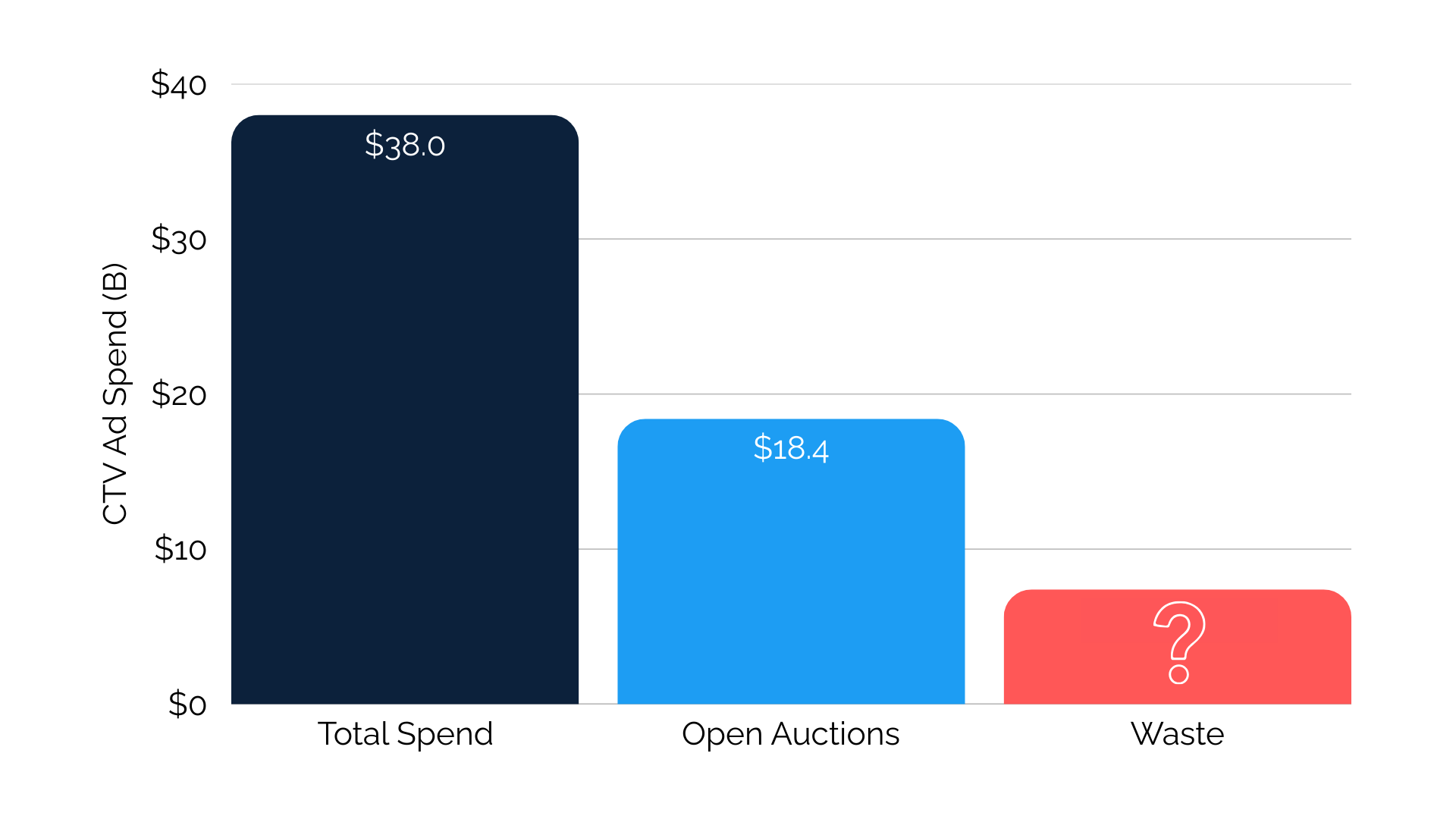
Truthset, which validates the accuracy of consumer data, estimates that $7.36 billion of the $38 billion spent on connected TV ads is being wasted because many campaigns aren’t finding their intended targets.
The finding was part of Truthset’s State of Data Accuracy report.
“What Truthset is doing is, step by step, trying our best to diagnose these pretty critical failure points in the data supply chain that supports all addressable advertising,” Scott McKinley, CEO of Truthset told The Measure.
“If marketers can’t rely on the data guiding their decisions, they’re flying blind. Truthset exists to change that by restoring confidence, accountability and profitability to the digital ecosystem,” McKinley said.
Inaccurate data also makes it harder for media companies to monetize their content.
The problem is particularly acute when it comes to free ad-supported streaming television (FAST) channels and other outlets that do not require that viewers sign up so they can be authenticated. Without authentication, IP addresses are used in billions of dollars’ worth of programmatic transactions and open auctions. Truthset says those IP addresses are often not connected to the individual with the characteristics the advertiser wants to reach.
Truthset found that IP to postal address linkages are accurate just 13% the time, and IP to email accuracy is pegged at 16%. Even matching email to postal is only 51% correct.
In terms of demographics, the signals are accurate on age segments 13% of the time and 41% of the time when it comes to identifying households with children.
Connecting IP addresses to actual people is already “abysmally bad” McKinley said. It’s going to get worse as IP addresses get rotated even more frequently, he added.
Truthset in 2022 set up its Data Collective, which was designed to help evaluate the quality, accuracy and reliability of data being used for ad-buying transactions. The results were eye-opening.
Since then, many of the big data companies that are part of the collective have worked to improve their data.
“Some of the data providers that participated in that study took that insight to hear and work to change the way they do their own assignments of people to households,” McKinley said. “And then if they’re part of the data collective, they saw their scores go up.”
One of the largest data providers saw their data rise to 54% accuracy in putting the right person in the right household, up from 32%, he said.
While data quality has improved somewhat since Truthset started its collective, McKinley said there are ways for the industry to improve data quality.
He said there is an old-school mindset that resists any solution that reduces scale to achieve better accuracy. But by making a change that might reduce their viewers by 15%, they could monetize the remaining audience five times better.
“They’ve got to throw out the records that are crappy. Stop stuffing your files to win the match-rate game or the scale game because better accuracy does matter,” he said.
But it will still be difficult for programmers working in the open internet to compete with digital giants like Amazon and Google, which operate behind walled gardens. They know exactly who their users are and can accurately connect their identities to their media habits and buying patterns.
Because their users are authenticated, they don’t have to pay the ad-tech tax to stitch together the probable identities of their users, McKinley said.
He says FAST channels must work harder to authenticate their users by recognizing that the value they provide is worth signing up for. “That’s the only way you’re going to get anywhere near the yield for your audiences that you’re attracting that the big tech companies are getting.”
With their more accurate targeting data, Amazon and the like can get prices of $20 to $30 on a cost-per-thousand viewer basis for TV commercials, compared with one-tenth of that for FAST channels, he said.
The user experience is also hurt when viewers are exposed to commercials that are not relevant.
Even in cases where there is some authentication, the data is rarely interoperable. If someone signs in to their smart TV, that information isn’t shared with the programmer looking to sell ads.
Despite the dire statistics, McKinley said he believes the state of data is slowly getting better. He gave Truthset some of the credit for that because buyers now have a source to check on the quality of the data being used for targeting.
“We try really hard to tell everybody that these problems exist and they’re fixable,” he said. “In terms of improvement. It’s not enough. It’s not fast enough,” McKinley said.