
Market Research’s Spinning Jenny Moment
Or why automation doesn’t shrink an industry; it unlocks it.
This is a guest post from Tom Weiss, Chief Product and Technology Officer at MX8 Labs.
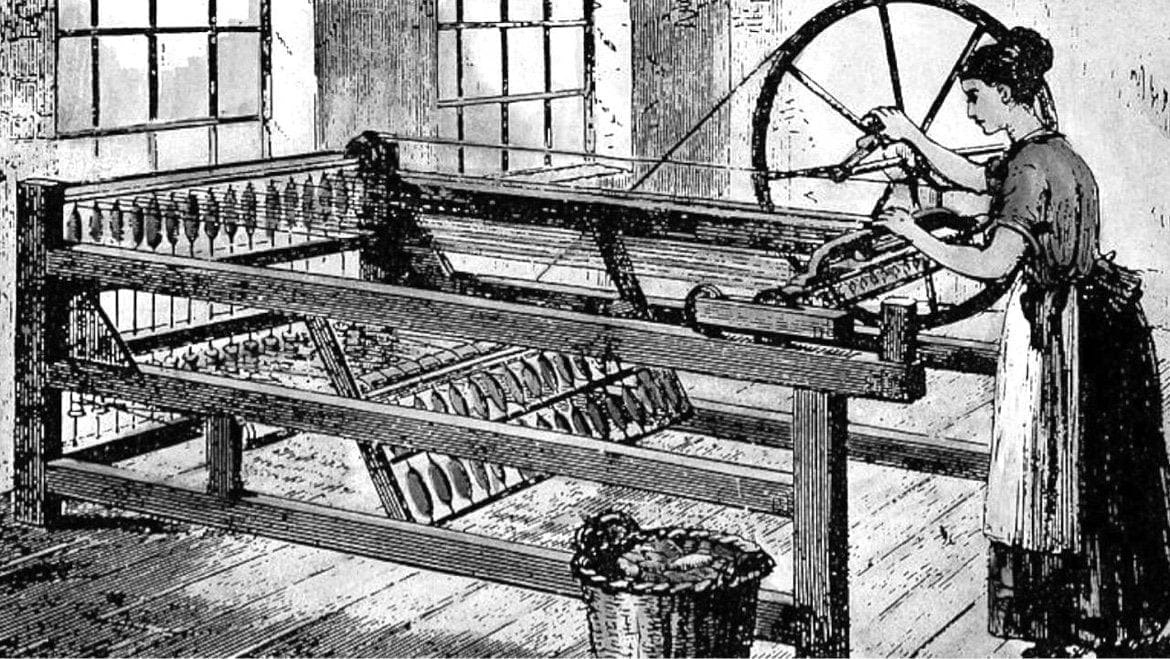
In 1764, James Hargreaves built the Spinning Jenny, a device that let one worker spin several threads at once. The earliest version handled eight. Later models managed dozens.
The result wasn’t marginal. Yarn production soared; costs collapsed. The bottleneck in textile manufacturing—hand-spun thread—suddenly cleared.
Before the Jenny, weaving teams had to wait. After it, weaving accelerated to keep up. The industry didn’t contract. It scaled.
But the technology wasn’t the most important part of the story. The reaction was.
Fear always arrives first

Hargreaves’ invention didn’t land softly. Four years after it appeared, rioters broke into his home and destroyed his machines. They believed, correctly, that the economics of their work had changed. They just couldn’t yet see what would replace it.
He fled to Nottingham. The machines spread anyway.
Decades later, the Luddites would do the same. New productivity meant new fear. That part doesn’t change.
Today, it’s AI. The conversation is familiar. People working in knowledge roles—researchers, strategists, analysts—see automation showing up inside their workflows. The instinct is protective. But the long-term pattern rarely follows the fear.
Yarn got cheaper. Cloth got cheaper. Demand increased. The textile workforce didn’t vanish. It grew, in size and in variety.
Automation removed the bottleneck. Then the industry expanded into everything that had been waiting behind it.
Research has been spinning by hand
For the past twenty years, insight work has followed the structure of its tools. Surveys had to be scheduled. Cleaning was manual. Charting was slow. Each step dictated the rhythm of the next.
We built long cycles and inflexible plans not because those were optimal, but because the process required them. We ran annual trackers because real-time measurement wasn’t feasible. We tested small concept lists because testing more took too much effort. We published reports for decision-makers because real integration into decisions wasn’t yet practical.
Most research wasn’t designed around the needs of the business. It was designed around the constraints of delivery.
Now, those constraints are breaking.
Insight production is collapsing in cost and time
Surveys can be created and deployed in hours. Data cleaning and coding can be instant. Charting and summary analysis are already there.
What used to take weeks can happen by the end of the day.
And when the constraint lifts, behaviour shifts. Research teams start testing more ideas. Supporting more hypotheses. Asking better questions. Moving in closer step with the business, not just reporting on it.
It’s not that curiosity was ever lacking. It’s that the process couldn’t keep up.
Now it can.
What grows is not the machine, but the demand
The yarn didn’t matter. The weaving did.
In research, it isn’t the automation that carries the value. It’s what becomes possible once the friction disappears.
Insight teams can stop explaining their timelines. They can stop defending their headcount. They can stop positioning themselves as an expensive, slow-moving gatekeeper.
Instead, they can run at the speed of the questions. Not all of them. But more of them. Enough to matter.
As research gets faster and cheaper, its reach inside the organisation expands. So does the need for people who know how to handle it.
Not just to execute. To interpret.
And that’s where the job changes.
We won’t need fewer researchers; we’ll need better ones
Automation is already handling the mechanical parts: formatting, scripting, filtering, tagging. It will continue to get better.
But that doesn’t remove the need for humans. It clarifies where they matter most.
We will need researchers who can judge what’s useful, not just what’s true. Who can synthesise contradictory signals. Who can design better questions. Who can move fluidly between quant, qual, and behavioural. Who can bring context into the conversation, not just data.
AI can do the repetition. It can’t do the thinking.
That doesn’t eliminate roles. It changes what those roles are for.
The real risk isn’t automation. It’s inertia.
The organisations most exposed aren’t the ones adopting AI. It’s the ones that fail to change their research architecture in response.
If your team is still working on cycles shaped by what used to be hard, you are already lagging behind.
The gap will not be between companies that use AI and companies that don’t. It will be between companies that changed their internal model to match, and companies that left their workflows intact.
Just as spinning didn’t survive without the Jenny, insight teams won’t survive if they stay built around manual production timelines.
There is no structural advantage to being slow.
This is the expansion moment
AI will change the way research operates. But not by making it smaller.
It will make it too central to ignore.
The real shift isn’t technological. It’s architectural. A cheaper, faster, more flexible insight engine invites a different kind of business culture. One that asks more, listens more, and adjusts more quickly.
Research becomes not just a checkpoint, but a habit.
The Spinning Jenny didn’t kill the textile workforce. It made it larger, more varied, and more economically powerful.
This will do the same.
The only open question is whether your team will grow with it.