
Local CTV Advertisers To Face Crunch in Third Quarter
World Cup, political campaigns increase demand in quarter when local businesses traditional found lowest rates, according to AdImpact data


Connected TV advertising has been a relative bargain for local advertisers, but that is expected to change in the third quarter of 2026.
According to data in AdImpact’s Local CTV Ad Trends Report, national advertisers don’t tend to advertise on CTV outside of the top 50 markets, so commercial inventory has been cheaper there. And there are a lot of impressions available in those smaller markets. Despite having only a third of the U.S. population, those markets accounted for 52.5% of local impressions in 2025.
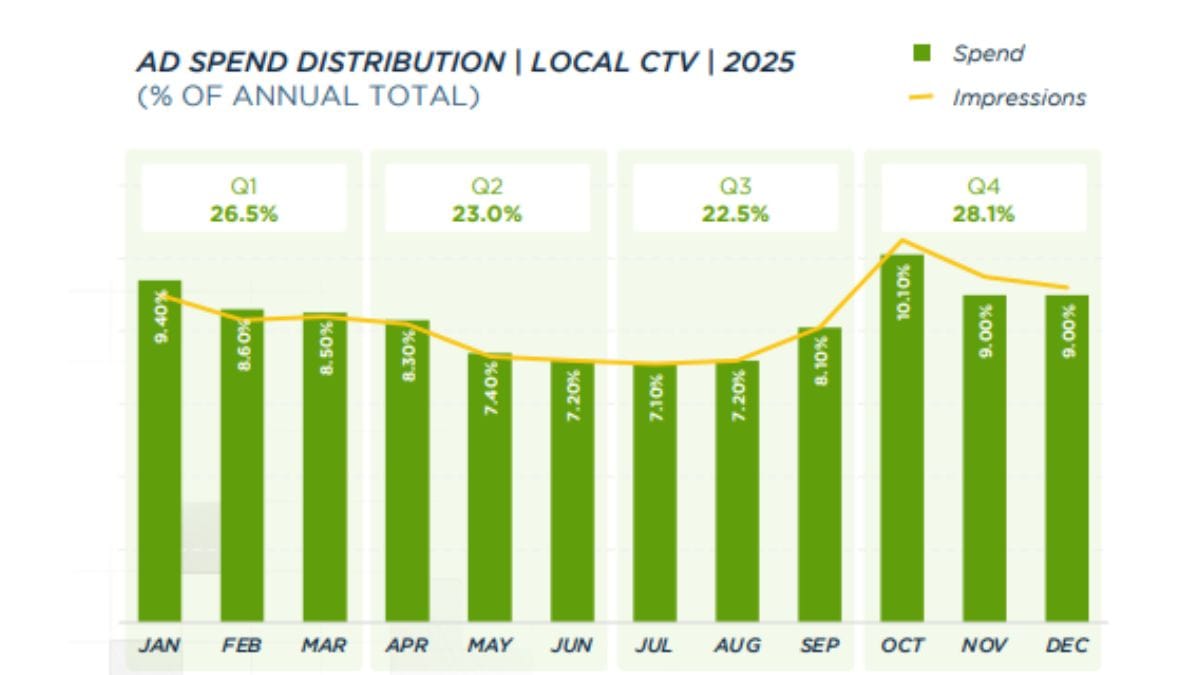
Historically, the third quarter had been a sweet spot for local advertisers, a time when national demand was low in most markets, resulting in efficient pricing for CTV impressions. Upcoming events are going to change the dynamics of the local CTV market.
The presence of the World Cup in the U.S., with 104 matches being played in 16 markets during 3Q. AdImpact said national demand will flood markets such as Dallas, Houston, Los Angeles, New York and Seattle. “Your most affordable quarter just got more expensive,” the report says.
AdImpact predicts that political spending on CTV will be $2.48 billion in 2026, up 128% from the 2022 midterms. “Political buyers don’t negotiate in competitive markets. They will out bid you. Wait too long and your inventory is gone,” the report said.
“As we enter Q2 and the rest of the year, events like the World Cup and midterm elections will reshape local CTV inventory, said Don Norton, general manager, data solutions at AdImpact. “As demand and costs increase, local advertisers will have to shift their tactics to account for more competition. By understanding how the market looked last year and which time periods delivered the most effective CPMs, advertisers can get ahead of the crunch and position themselves to maintain their market share.”
AdImpact has been tracking political spending during this mid-term cycle. Already, it has seen about $2 billion in spending across broadcast, cable, radio, digital, CTV, and satellite.
Some of the biggest spending races are the Texas Senate, with $135 million spent so far, California governor at $115 million, and Maine Senate at $103 million.
The top advertisers include: Steyer for California Governor ($89M), the U.S. Department of Homeland Security ($80M), Jackson for Georgia Governor ($43M), One Nation ($42M), and Krishnamoorthi for Illinois Senate ($29M).
The top markets for political spending are Washington, D.C. ($141M), Chicago ($97M), National ($86M), Los Angeles ($77M), Atlanta ($71M)
Republicans’ share of spending was 40%, compared with Democrats at 31% and independents with 29%.
Broadcast is attracting 32% of political advertising spending, with CTV getting 25%, digital receiving 24%, cable attracting 17%, radio getting 2% and satellite seeing 1%.
At this point, 71% of the spending is on issue advertising, compared to 29% for specific candidates.
# # #
Consumer spending on video is expected to be relatively flat over the next few years, according to a new report from analyst Robert Fishman at MoffettNathanson.
Fishman says that between 2019 to 2025, spending on video rose from $140 billion to $144 billion, a compounded annual growth rate of just 0.4%.
He blamed the decline of pay-TV in part for the lack of growth in spending on video, plus overall depressed consumer sentiment.
Consumers are shifting more of their discretionary spending away from in-home entertainments, such as video, to out-of-home experiences and live events, Fishman said.
Video advertising is growing modestly, he adds.
All of this is reflected in Fishman’s investment recommendations. He has buy ratings on Alphabet, Cinemark, Disney, Live Nation and Netflix. He is neutral on Fox, Paramount Skydance, Roku, TKO and Warner Bros. Discovery.
# # #
Spectrum Reach has become the first ad seller to join DoubleVerified’s Certified Transparent Streaming program.
The program enables advertisers to see show-level data across Spectrum Reach’s programming including news and live sports, for spanning both direct and programmatic buying. These data insights will be available within DV Authentic Streaming TV reporting, giving advertisers verified, post-bid visibility into the specific programs their ads ran alongside, the companies said.
“Advertisers have made it clear that show-level transparency is not optional — it’s foundational to trust and performance in streaming TV,” said Todd Randak, GM of CTV at DoubleVerify. “By working with Spectrum Reach to enable compliant, program-level reporting at scale, we’re continuing to raise the standard for transparency while helping brands drive stronger outcomes. We expect to announce additional partners in the coming months as momentum builds around program-level transparency across the streaming TV ecosystem.”
The show-level data enables advertisers to better understand how contextual relevance drives outcomes and optimize future streaming investments.
“We’re bringing show-level transparency to premium streaming inventory, not just telling advertisers which app their ads ran in, but which program they ran alongside,” said Alexander Groysman, VP, product management at Spectrum Reach.
“Spectrum Reach is enriching our content metadata with the granular signals advertisers have been asking for and integrating it directly into programmatic infrastructure. Our partnership with DoubleVerify ensures this transparency is delivered in a privacy-focused, scalable way that drives stronger outcomes for brands,” Groysman said.
DV announced its Authentic Streaming TV product in January.