
How AI Is Changing the Way Viewers Find What They Want to Watch on TV
Gracenote report says chatbots need accurate program data to produce trustworthy results

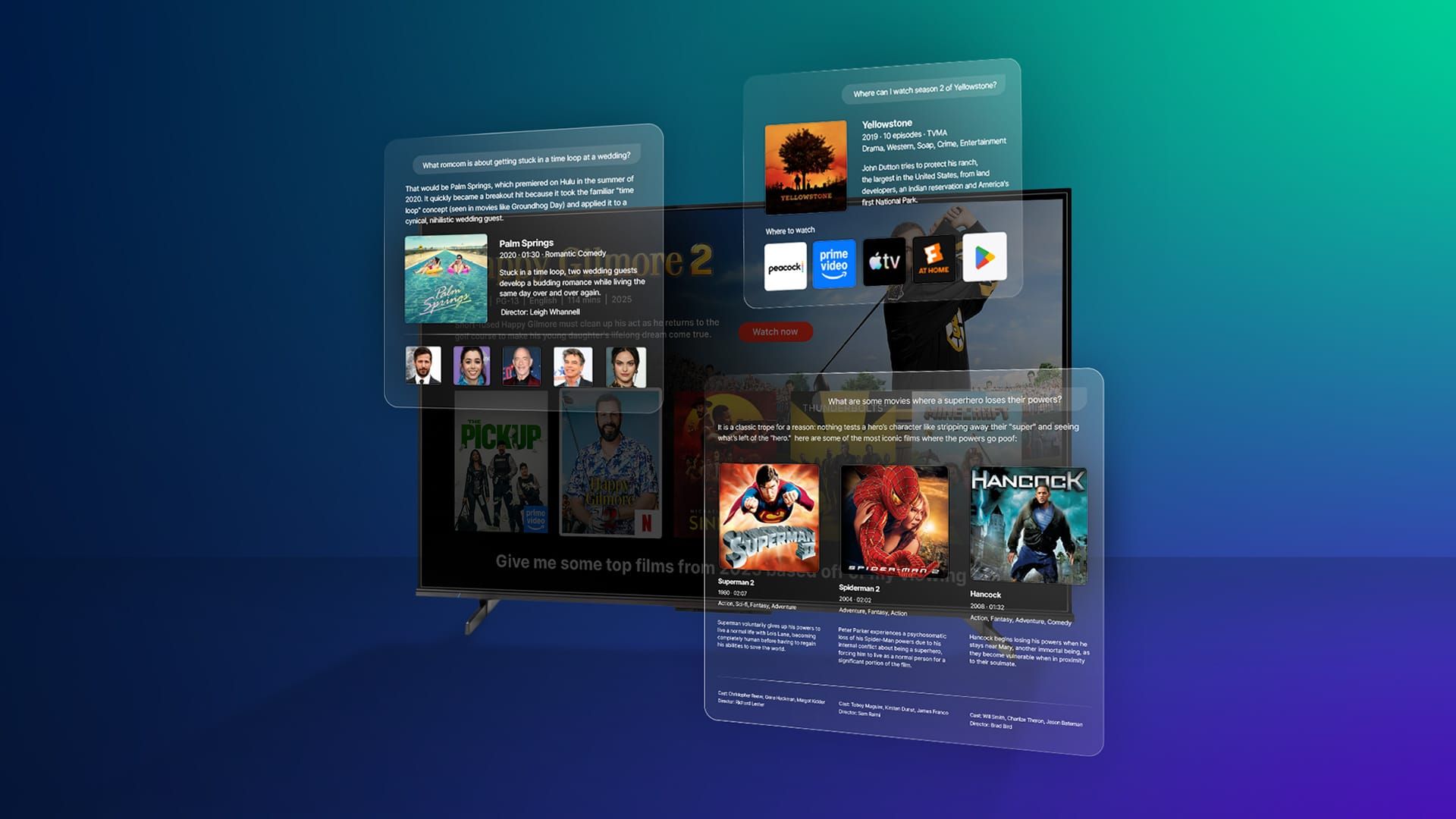
Forget artificial intelligence. I can remember when you didn’t have to be all that smart to figure out what was on the boob tube.
Keeping track of what was airing on just three networks was pretty easy. If your favorite show was Batman, you knew the right Bat-time and Bat-channel, so you didn’t miss that week’s episodes. (Yes, episodes. For a while, there was the cliff hanger episode, followed the next day by the resolution episode. But, that’s another story.)
Cable made TV more complicated. As the Boss put it, there were 57 channels and nothing on. To find the right nothing, cable companies provided the notorious scrolling channel guide that one could stare at for hours and still not know what was on Trio.
TV technology marches on, giving us more choices, but the development of tools to find what we want to watch seems to have lagged, especially now that we’re in the era of streaming and oceans of available content.
Despite the wisdom of algorithms that put what we should want to watch front and center, sometimes our hard-to-predict tastes drive us to seek out obscure, forgotten titles.
The owners of all this content, and the various channels, services and platforms that license TV shows and episodes, want viewers to find something they want to watch and enjoy. That way they’ll happily pay the ever-growing bill at the end of the month. On the other hand, if we spend 10 minutes searching for content, our loyalty to our provider might waver.
The answer to this paradox of TV choice is artificial intelligence. As always when artificial intelligence is the solution, it also raises new questions and issues.
In its new report, TV Search and Discovery in the AI Era, Nielsen’s Gracenote division says that the growing consumer use of chatbots is reshaping the way viewers, especially those young Gen Alpha viewers, find what they want to watch. When asked to name the best source for TV and movie recommendations, 49% of the Gen Alpha members surveyed chose web- and app-based AI chatbots. The streaming and cable service user interfaces and program guides were named by 41% of the Gen Alpha respondents and 11% picked internet search results.
It’s not just the whippersnappers. In the survey, 57% of all respondents said AI chatbot tools could become, or already are, their favored way to find out what they want to watch, where that is available and when they can see it. Overall, 52% of U.S. consumers believe AI chatbots have the potential to become their favorite source for entertainment information and 66% of consumers believe AI will be important in providing good entertainment experiences.
“People are rapidly embracing AI as a new way to search, discover and decide what to watch, especially Gen Alpha audiences, who already expect easy-to-use, conversational interfaces,” said Tyler Bell, senior VP of product at Gracenote. “But adoption alone is not the story: trust is. The winning platforms will be those that can deliver viewing experiences people can actually rely on — grounded in vetted, timely and high-quality data.”
Of course, the catch is accuracy. When it comes to chatbots, users don’t always trust the results they get. When it comes to trustworthiness, traditional search was preferred by 50% of the respondents, compared to 27% for chatbots, and when looking at accuracy, 46% said search was better, above the 33% who like what chatbots are giving them.
Because they are skeptical about the results they get from AI, users often double-check them, with three in four respondents saying they verify chatbot responses, mostly by cross-checking with internet search. The group that had the most faith in what chatbots told them were younger users. Among Gen Alpha, 95% regarded the accuracy of AI favorably, compared to 99% for traditional search.
Across the study, chatbots were trusted most for TV and movie recommendations compared to other use cases, with 25% saying AI was a reliable way to help find TV, movie and sports programming.
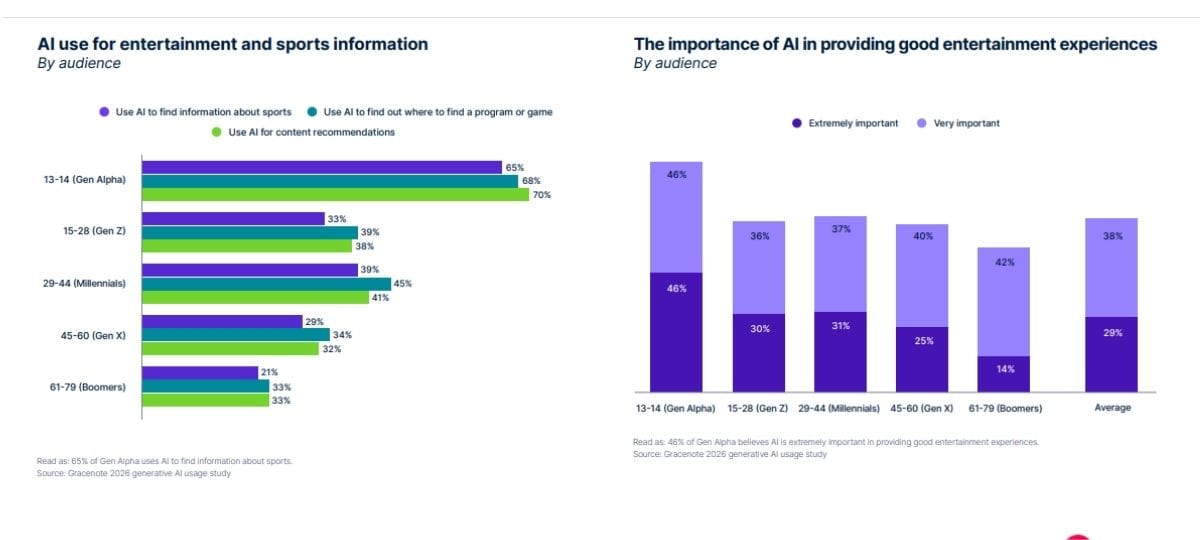
According to the survey, users prefer chatbots for complex questions, follow up questions, direct answers and comprehensive results.
The accuracy issue puts a spotlight on the importance of grounding LLMs with trusted and validated data sources, the report notes.
The quest to stay accurate requires even more work. “While training and fine-tuning an LLM with entertainment industry-specific knowledge can help, connecting an LLM to industry-validated data via the Model Context Protocol (MCP) ensures that an LLM’s knowledge base is never out of date,” the report says.
It is worth noting that Gracenote is a major supplier of high-quality data about TV shows and movies, and its meta-data is used for program evaluation by distributors, program discovery by consumers and contextual targeting by advertisers.
It is also worth noting the state of Gracenote’s relationship with AI. In March, Gracenote Media Services sued several OpenAI entities, charging that OpenAI and its ChatGPT are using Gracenote’s date without permission.
According to the suit, “Without permission or compensation to Gracenote, defendants have copied and used Gracenote data to create and improve highly lucrative AI products like ChatGPT, powered by large-language models.”
The suit adds that, “Defendants’ AI products contain and generate exact copies of Gracenote data, including outputting Gracenote Data’s descriptive content verbatim.”
Gracenote alleges this behavior threatens its core business and endangers its future by harming Gracenote’s value in the emerging market for training AI products.
Back to the report. Gracenote says it is based on an online survey of 4,003 U.S. AI chatbot users ages 13-79. The survey was conducted January 23 to February 4, 2026. Its Gen Alpha findings are based on respondents ages 13 and 14. The report also draws on Gracenote’s 2025 Streaming Consumer Survey of 3,000 people worldwide.
“Today’s content landscape is too vast to navigate with legacy search functions— even within individual platforms and services. The introduction of GenAI for content search and discovery will facilitate a tectonic shift in user experience that has the potential to greatly reduce unfavorable viewer sentiment as content congestion and fragmentation hampers overall TV enjoyment,” the report says.
It notes that 34% of Americans said the overwhelming number of streaming services and the volume of content available is hurting TV enjoyment. Among people 18-34, the percentage is even higher, at 48%.
“As consumers grow increasingly comfortable with — even reliant on — GenAI for general information, they’re also tapping chatbots for information about entertainment and sports. Given audiences’ preference for GenAI results for direct, comprehensive and conversationally refined answers, there’s little doubt that they will come to expect similar experiences with their entertainment services,” the report says.
“To meet the expectations of consumers, LLMs need to overcome negative audience perceptions about accuracy and trustworthiness,” it concludes. “The overall concern among all consumers about the accuracy of chatbot results amplifies the need for both AI providers and publishers to anchor their LLMs and content experiences with trusted, industry-validated entertainment data. With so many content options available, many consumers may not be willing to give individual publishers the chance to repair a bad first impression.”