
66.7% of Ad-Supported TV Viewing By 18 to 49 Year Olds Goes to Streamers
New Nielsen guide says sports account for 29.2% of ad-supported viewing by 25–54-year olds

With the annual upfront ad market approaching, Nielsen has come out with a new data point that will drive senior sellers of traditional network advertising in search of another martini.
In its 2006 Upfront Planning Guide, Nielsen says that streaming now accounts for 66.7% of the time 18- to 49-year-olds spend with ad-supported TV.
That 18 to 49 demographic used to be the most important audience for those who buy and sell TV commercials. As the median age of the network TV viewer climbed above the 60-year mark, it became harder and harder to target young consumers with traditional TV, and the share of ad dollars going to streaming has grown.
So, it makes sense that Nielsen has begun looking at the demographic breakdown of viewers of free ad-supported streaming television (FAST) channels and ad-supported video on demand (AVOD), in addition to the big subscription streaming services.
The good news for advertisers is that 18-49-year-olds still see commercials when they watch TV. Nielsen says that 63.8% of the time those young adults spend in front of the tube, the programming is ad supported. Of that ad supported viewing, only 17.8% is on broadcast TV and 15.6% is on cable.
Of the time they spend watching ad-supported streaming, 18.9% is done on FAST platforms. The bulk is still with subscription services like YouTube, Hulu, Netflix, Prime Video, Peacock and Paramount+.
Looking at the older 25-54 demographic, 29.2% of all ad-supported viewing happens during sports telecasts. That number was taken during the fourth quarter, when the football season was in full swing.
Without sports, broadcast has only 9.8% of all ad-supported viewing by 25- to 49-year-olds, and cable has just 18% without sports.
As more sports move to streaming, the differences in the demographic profiles of linear viewers and streamers stand out.
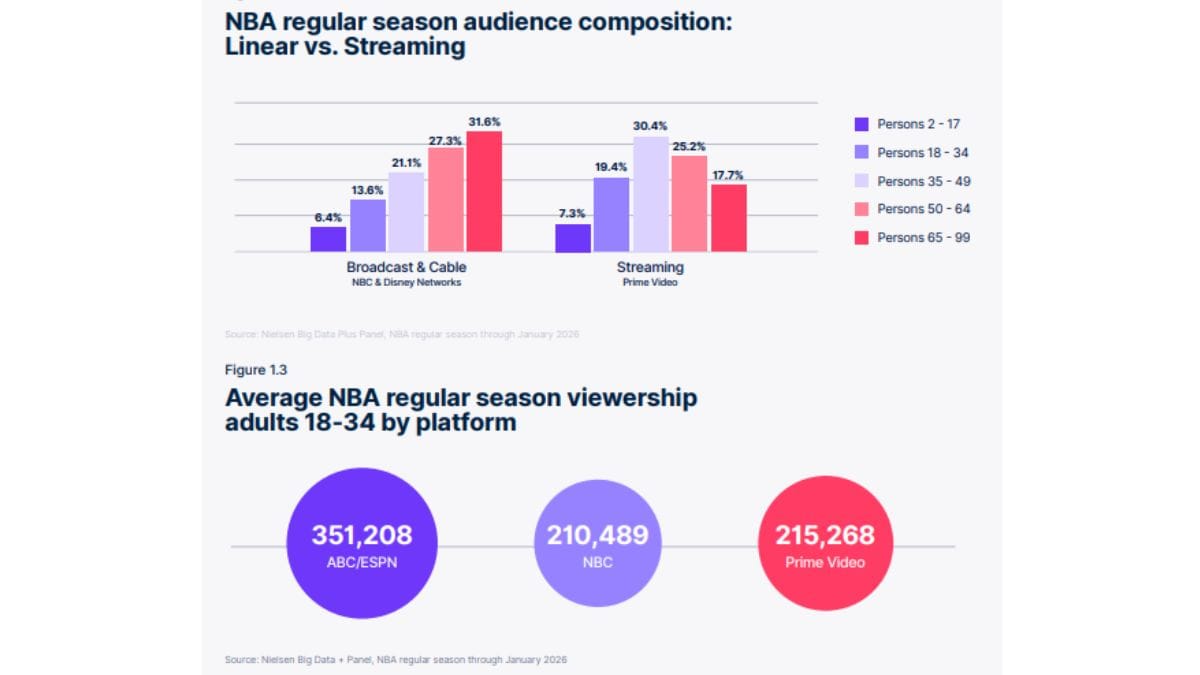
Looking at the NBA, which this season got a boost by moving a number of games to NBC, Nielsen found that the concentration of viewers in the 18-49 and 35-49 age brackets was higher on Prime Video than on the NBCU and Disney networks.
“The concentration of an audience is different from the volume,” the Nielsen guide notes. “So, while Prime Video delivers a higher percent composition of adults 18-34 with its streams, NBC attracts a comparable number of adults 18-34. Meanwhile, ABC and ESPN average the highest number of viewers in this demographic.”
Nielsen notes that the differing age profiles of the individual platforms might make them attractive to different advertisers.
“With upfront and newfront season upon us, we took an even closer look at FAST and AVOD to uncover new areas of growth as ad supported TV viewing evolves,” said Nielsen data communications director Brian Hughes. “We found that each pillar of ad-supported TV offers something to help brands meet their goals, and when used together, the opportunities have the potential to multiply."
Nielsen’s data is based on its new Big Data + Panel methodology.
Last week, the Media Rating Council noted that there were issues with Nielsen’s data, including a “seemingly unusual” 10% decrease in total day impressions among 25- to 54-year-olds.
The MRC noted that Nielsen had made progress in addressing its “priority areas” and that adjustments to Nielsen’s modeling and weighting processes are currently planned for implementation next month.
“We understand and we regret that these changes will be disruptive to business processes of the marketplace; we are encouraged that Nielsen is actively working to address the priority areas for improvement that have arisen in their Big Data + Panel measurement,” the MRC said.
A Nielsen spokesperson said that its Big Data+Panel data is accredited by the MRC and is the most accurate data it has produced.
# # #
With college basketball’s championship tournament about to start, Nexxen is sharing some data about March Madness from its audience intelligence tool, Nexxen Discovery.
Nexxen says that 45% of March Madness viewers don’t watch regular-season college basketball.
It says 89% of live sports fans co-watch with friends or family. That makes the tournament a social experience that multiplies exposure beyond a single screen.
Gen Z and millennial sports fans are particularly engaged through brackets, fantasy leagues and micro-betting. This shows a crossover between TV and interactive digital activity.
Engagement with the NCAA Women’s Basketball Tournament jumped 334% last March. Interest was driven by star players and social media momentum, according to Nexxen.
# # #
FreeWheel, Comcast’s ad tech unit, said it launched an AI agent system based on its Model Context Protocol server and intelligence tools. The system is designed to automate transactions and optimize performance.
PMG is the first media agency to integrate FreeWheel’s agentic system into its own platform, known as Alli.
“Often AI in our industry today is just a wrapper around generic models. What we have built with FreeWheel is true technical interoperability,” said Mike Treon, Head of CTV & Video Strategy at PMG. “By connecting Alli to FreeWheel in real-time, we have given our customers an agentic AI solution that goes beyond reporting and actually understands the streaming ecosystem. We are moving past manual setup to an era where teams use our industry-leading marketing operating system to optimize complex global deals instantly.”